Top Lawn Care Tips
Last Updated: June 10, 2025
 10 Jun 2025
How to look after your lawn
Getting a beautiful, thick and rich lawn can be a long process, and it requires lots of patience. However, it is very rewarding to have healthy grass in your garden to enjoy throughout the year.
If you’re not sure where to start with getting lush, healthy grass then read on as we’re sharing our top tips for looking after your garden lawn.
Mowing your lawn
Mowing is the most important process to achieve the perfect lawn; it is the foundation for everything you do afterwards. If you do this well, you are on your way to achieving healthy, rich and beautiful grass! Incorrect mowing practices are the easiest way to ruin a lawn. It is therefore important to invest in a quality lawn mower, with adjustable blade height and a large box for collecting the cuttings.
Our rotary mowers are professional lawn mowers - they are high quality pieces of gardening equipment, designed to perform to the highest standards.
Before mowing your lawn, you should clear all obstacles, toys, and the washing line! Also, remove any leaves with a leaf blower or a rake.
How to mow your lawn
Set the lawn mower to a higher cut setting and mow the lawn in straight lines, overlapping slightly on each pass with the line that you have already mowed. Then reduce the cutting height of the blades and mow again. Repeat this process until you get the cut that you want. It is best not to go straight to a short cut, as this will shock the grass and it will not give you the perfect lawn finish. It is advisable not to go below 3/4”, to avoid scalping the lawn. In the height of growing season (late spring - summer) you should cut your lawn once a week.
When mowing slopes in your garden, mow across the slope rather than up and down. Finally, tidy up any borders with a pair of long handled lawn edging shears.
For the best results every time, ensure that you clean the mowers blades after each use to ensure a consistent high-quality cut (make sure the mower is not switched on whilst doing this!) Also, if you own your own lawn mower, ensure that you change your lawn mowers blades every year, as the blades will become blunt over time.
You should wear appropriate footwear whilst using a lawn mower, and always turn off and unplug a mower before you attempt to adjust the height or change the blades. If you are using an electric mower, take care not to mow over the power cable.
Scarifying your lawn
Scarifying your lawn removes thatch (organic matter like twigs, leaves and weeds etc.) This effectively removes any unwanted matter, leaving space for you to grow fresh grass, so your lawn will be rejuvenated with thick grass growth.
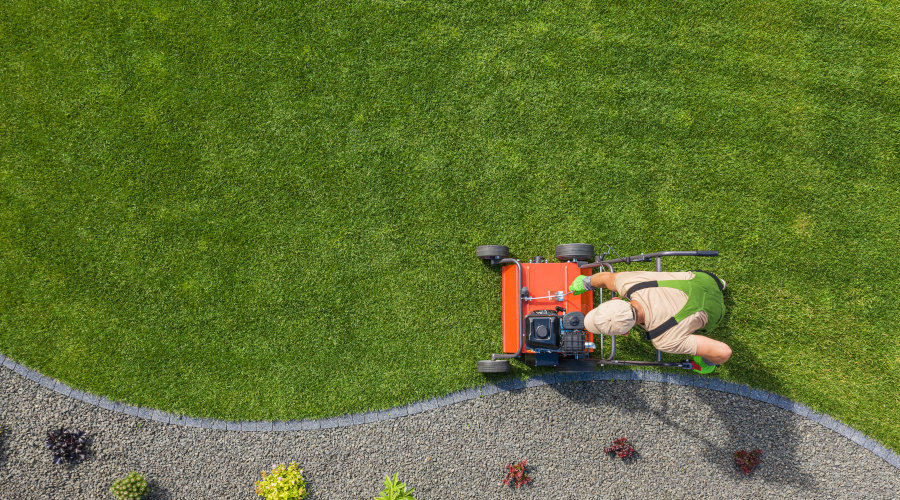
Lawn scarifiers come in all shapes and sizes. For a small garden, an electric scarifier would suffice. For a larger lawn (and for the best results) a petrol scarifier is ideal. Lawn scarifiers house a series of fine blades which turn along the grass as you walk, teasing out the thatch and helping to prune the grass. Whilst using a scarifier, you should follow the lines you set when mowing the lawn.
Scarifying a lawn can make it look quite bare - especially if it has been overrun with moss and other thatch. Do not worry. Think of scarifying as stripping back your lawn to leave just the grass, and then you can build from that to create a beautiful, rich lawn.
It is important to scarify only during ideal weather conditions – when there is sunshine, warmth and there has been some rain. If you scarify when there has been heavy rain, or extreme conditions like a drought, you will do more damage than good, as the grass will not be able to grow back for a long time after you have scarified it.
Aerating your lawn
If your soil is compacted, you will have problems with drainage, and the grass roots in your lawn will be starved of key nutrients and air to flourish. Problems with drainage can also lead to moss in your lawn, as it thrives in the damp conditions.
Aerating your lawn allows you to decompact the soil and improve drainage to allow nutrients to get into the soil and feed the grass roots. Using an aerator is a similar process to scarifying - just walk along with the machine, following the lines you made whilst lawn mowing. As you walk along, the aerator's tines punch tiny holes into the lawn to improve drainage and help healthier grass growth.
Read our guide to aerating your lawn
Overseed your lawn
Overseeding your lawn involves scattering new grass seed over your lawn, to fill gaps and promote thicker grass growth. This is key after you've scarified and aerated your lawn. As scarifying can often scalp your lawn if it has been in a particularly bad state, so the overseeding helps to fill the gaps where there was once thatch, with new healthy grass.
As the seed takes to the lawn and starts to grow, you will quickly notice the difference in your lawn. Where there was once thatch, weeds and moss, there will be healthy green grass. And, as you aerated your lawn to improve drainage and allow nutrients into the soil, the new grass will flourish.
Treat weed, moss & pest problems
Weeds and moss take up space that would otherwise be filled by beautiful green grass and starve the area around them of the vital nutrients in the soil. So, removing weeds and moss is a job you need to schedule if you want your space to look perfect.
Remove large weeds from your lawn with a trowel or small garden fork. Treat any mossy areas with a specialist moss product. Autumn is also a good time to resolve any fungal or pest problems. Any grassy area can suffer from red thread, fairy ring, take-all patch, slime-mould, and lawn lichens. You can read up on what they are and what causes them, so you know how to remove and prevent them in future.
Common garden pests like leatherjackets and chafer grubs are something you might need to be aware of. In addition, you can also look out for worm casts, which are caused by some species of earthworms, and can look a little messy sometimes.
Level your lawn
Bumpy and uneven spots of your garden lawn can happen naturally and gradually. But, because it’s a slow process, it can happen without you even noticing.
The dips of high and low spots can cause problems. These little areas can become hotspots for weeds, moss, trapped moisture, bald patches, hard lumps, and uneven grass. These aren’t the most attractive features of a garden.
Depending on the size of the job, there is a range of tools you might buy or hire to make the project more manageable. For example, garden rollers and plate compactors make the job a lot easier.
For an in-depth guide, you might find our blog How to Level a Garden Lawn helpful.
Apply top-dressing, seed & fertiliser
Adding a mix of loam, sand, and compost can correct bumpy surfaces, fill low spots, and improve some heavy soils' texture. If you have used an aerator with hollow tines, a top-dressing fills the holes, allowing grassroots to grow.
If you have scarified, you can then overseed your lawn by spreading grass seed over the entire space, giving special attention to bare spots. You can also feed your lawn with a high-quality autumn fertiliser — low in nitrogen and high in potash. This will help to strengthen your lawn and toughen it up for the harsh winter months.
Autumn fertiliser can be applied any time from September to mid-November. When the weather is fair, the soil is moist, and the grass is dry and frost-free, as these are the perfect conditions for your lawn to recover following the quite harsh processes of aeration and scarifying.
Clear your lawn
In the autumn and summer months, it is important to allow your lawn to get as much sunlight as possible before the short, cold days of winter arrive. To ensure your entire lawn gets as much sunlight as possible, remove any obstructions. For example, you might have outdoor furniture, DIY materials, children's toys, and other objects hanging around from making the most of any hot weather.
In autumn, rake the lawn regularly to remove any debris and leaves which may have fallen. This will help to prevent the yard from 'yellowing' due to a lack of sunlight. Doing this can also avoid waterlogging.
Lawn maintenance tips
Once you have a healthy, rich and full lawn, remember to keep mowing regularly. 'Little but often' is the key - taking a little amount from the top of the grass regularly, during the height of growing season.
Be patient when caring for your lawn
The key is patience. Don't overload the lawn with blades and machinery all at once, and don't rush into following these lawn care practices if the weather conditions are not right. You must not complete this process in one afternoon - it would cause more damage than good. You must carry out these lawn care practices carefully and regularly, over a period of months, to achieve the perfect, professional looking lawn each year.
Stay safe
Make sure you read the manuals for the machines and equipment mentioned in this post thoroughly before using them. Wear appropriate clothing and gloves, especially when dealing with blades. Do not try to service a machine whilst it is still plugged in or switched on.
Book garden tool hire
Take a look at our range of garden tool hire. You can book a hire online using our booking system or over the phone with our hire team!